
The Great Wildebeest Migration 2027 | Everything to know, What, when & where
Great Wildebeest Migration 2027 | What, when & where Understanding how the Great Wildebeest Migration moves with in the year is very important most especially to the new travelers. Knowing the best time to go on a wildebeest migration Safari, What are the best wildebeest Migration safari packages
One of the East African Safari moments to experience is the Great Wildebeest Migration that happens with in Kenya and Tanzania. This event is one of the popular natural wonders that creates unforgettable memories . Kenya and Tanzania are some of the countries with the most exciting and impressive wildlife events as a big number of animals roam through Serengeti and Masai Mara national park.
The wildebeest migration is one of most perfect ways to experience the wildebeests or Zebras moving in lines as there crossing the river. These wildebeest species are also categorized as a member of the antelope family, there are identified as species with large, box-like head with the curving horns.
Every year one of the greatest breathtaking wildlife events earth unfolds through the vast plains of East Africa (the great Migration of wildebeest. This is described as the greatest show on the Earth. This natural phenomenon involves over 1.5 million wildebeest, these are accompanied by Zebras, gazelles as they be searching from fresh pastures
The Great Migration
The great Migration is one of the sought after experience for wildlife experience with in East Africa. This is one way for travers who love nature to richly experience it. The experience is referred to us the continuous rotation of a million wildebeest species with in the ecosystem of Serengeti and Masai Mara.
These species are driven by the search for grazing and water, these wildebeest is a accompanied by Zebras and other species, well other predators like lions also follow to make these wildebeest species there food which makes wildlife safari interesting. So as they move with in southern Serengeti near the Ngorongoro conservation area in Tanzania, they move through Serengeti towards Kenya’s Masai Mara before returning again at the end of the year
Premium packages for the Great Wildebeest Migration Safari
As an African safari and tours, Corazon safaris Africa organizes the most exciting and best great Wildebeest migration Safari. Our itineraries a thought fully designed to align well with the preferences of our travelers. The packages are seamlessly designed considering the desired highlights, your preferred level of adventure including a lodging style of your choice.
And as for creating memories out of photography, we will definitely assist to create an ideal time for you to capture the dramatic wildebeest crossing the river.
The tips for planning your great wildebeest Migration
A meticulously planned trip will ensure will absolutely serve you the best adventure. Below is what to include in your plan
Strategically book well in Advance: To plan the great migration requires planning a year in advance that can be 12-18 months on advance for the peak season of July to October to secure camps. So if your targeting a calm environment with zero crowds, consider the shoulder season between April, May and November
Consider Privacy: Since the great Migration of wildebeest in Masai mara and Serengeti are exciting with massive viewing, they can easily e congested. So in order to avoid the crowd, book camps with private conservancies. You will definitely access to the night drives and off road viewing
Target your experience: This involves arranging your timing carefully. The migration can be continuous year around circle not just a single event. So the Mara crossing happens between July and October. For the calving season as numerous babies are born and where the big predators become active, visit the Southern Serengeti in Ndutu region between January and March
For a hustle free and seamless planning contact a safari specialist to take you through a tailored itinerary which can align with your travel preferences
Major Great Wildebeest Migration Itineraries

7 days Great Migration Safari
A 1 week Great Migration Safari basically focuses on immersing and explorer the wildebeest species with in Northern or Central Serengeti national Park for a 3 to 4 days depending on the season. The safari features an iconic stops in Tarangire, Ngorongoro or lake Manyara. The Safari starts and ends in Arusha
Serengeti & Masai Mara Safari
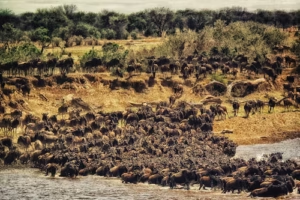
The 8 days safari in Tanzania and Kenya is one of the perfect itineraries for those who are seeking to have a remarkable experience of the annual migration, having a massive wildlife experience. On this safari you will visit places like the mighty Masai Mara and the unmatched Serengeti national park in Tanzania.
Great Migration Kenya and Tanzania
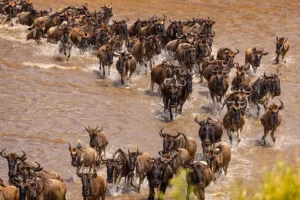
Experience the annual event that happens in a year with a thousand wildebeest species crossing the river. The wildebeest species are combined with Zebras and gazelles that run through Serengeti in Tanzania and Masai Mara in Kenya. The movement is driven by the search of water and grazing green pastures. Massive 14 days

Gorillas, Great Migration & Zanzibar
These are massive 12 days of trekking gorillas in Uganda, Great trekking and a Zanzibar beach experience which definitely offers a massive East African adventures. The tourists basically trek gorillas in Uganda’s Bwindi or Volcanoes in Rwanda, sight see the great migration in Tanzania plus a beach experience in Zanzibar
9 days Tanzania Northern Circuit Safari
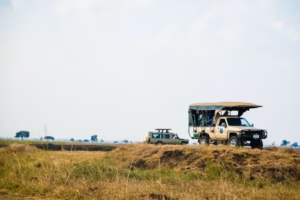
The safari is combined with the iconic Tanzania destinations like the Tarangire, Lake Manyara, Ngorongoro crater, almost involves the endless Serengeti. Expect to sight see the massive big herds of elephants, tree climbing lions, and the big five. Don’t miss the game viewing in over a well smooth daily rhythm

Great Migration & Zanzibar Beech
This combines a wildebeest and a Zanzibar beach safari that may offer a massive Tanzania experience that pairs sight-seeing of wildebeest species in Serengeti as the wildebeest and Zebras cross the river, it can be either calving in Jan-March or river crossings. Plus a relaxation at the beach in Zanzibar’s white sand beaches
The Major facts about the Great Wildebeest Migration
Among the many natural events that occur around the world, few compare to the extraordinary scale of the annual Great Wildebeest Migration across the Serengeti–Mara Ecosystem. The crossing of the a thousands wildebeest species including the Zebras are driven by the rains. Here are some of the facts
During the wildebeest migration, the species travel roughly 1000 kilometers in the year looking for fresh pasture and water. This migration follows the seasonal rains which determine were the fresh grazing is available. Furthermore, one of the most dramatic moments is the river crossings most especially at the Masa Mara River.
During this Migrations, the predators hardly survive along the journey due to the following predators, drowning, diseases and exhaustion. In addition around 500,000 calves are born with few weeks during the calving season in the southern Serengeti. Basically, this journey is continuous circular journey not just a single a single trip from one place to another
Understanding the Epic Great Wildebeest Migration
The great wildebeest Migration is the popular largest movement of wildebeest species on the earth and it is known as one of the nature’s most extraordinary spectacles. It involves 1,000 animals per square kilometer, these wildebeest can be seen in a far space.
Basically, each year more than 1.2 million wildebeest, accompanied by approximately 300,000 zebras, as well as several species of gazelles, continuously roam the Serengeti–Mara ecosystem in search of fresh grazing lands and reliable water sources. Guided by instinct, every wildebeest travels between 800 and 1,000 kilometers along ancient migration routes that have been followed for generations.
The migration follows a circular route beginning in the Ngorongoro Conservation Area (excluding the Ngorongoro Crater) in southern Serengeti, Tanzania. From there, the herds move north through the Serengeti into Kenya’s Masai Mara before eventually returning south to complete the cycle. Along the way, countless dangers await young calves fall victim to predators, slower animals are brought down by lions, many are injured on steep riverbanks, crocodiles lie in wait at river crossings, and the weak or exhausted often perish while attempting to cross swollen rivers.
The Great Wildebeest Migration January to March
Each January, the Great Wildebeest Migration reaches the southern end of its annual cycle as the herds move across the eastern edge of the Serengeti into the Ngorongoro Conservation Area. The nutrient-rich short-grass plains provide ideal grazing conditions, making this the perfect place for wildebeest to give birth and nurture their newborn calves.
Although the Great wildebeest Migration has no true beginning or end apart from the natural cycle of birth and death the calving season is widely regarded as the start of the journey. From late January through February, vast herds gather on the short-grass plains stretching across the northern slopes of the Ngorongoro Highlands and around Olduvai Gorge.
The arrival of so many vulnerable calves attracts a variety of predators, creating some of the most dramatic wildlife encounters of the year. For travelers hoping to witness the calving season and the intense predator-prey interactions, Asilia’s mobile camps in the southern Serengeti Olakira, Kimondo, and Ubuntu offer excellent access to the heart of the action.
Great Migration between April to May
The great wildebeest Migration is one of the most attractive and exciting event that happen each year as millions of wildebeest along side Zebras and other grazing species travel from Serengeti’s Tanzania to Masai Mara’s Kenya to search for pasture
So during the April and May Migration, is usually in the North west part of Serengeti and this period is the rainy season time and its when the plains become rich with fresh vegetation. April is also when the young calves born earlier in the year as they grow more stronger as they prepare for the journey ahead
During, May, the herds begin moving northwards as it approaches dry season. These animals travel in large groups as they follow the ancient routes as passed down through generations. In addition, there journey during this time is filled with challenges as they cross rivers to avoid predators like lions, crocodiles and traveling long distance.
Meanwhile, the Great wildebeest Migration in April and May shows the incredible connection between the animals, weather plus the environment. And this is a powerful example of nature’s cycles hence remaining one of the awesome experiences creating beautiful sight memories
The July to October great wildebeest migration
During this time, it’s the most dramatic phase of the annual movement of wildebeest in East Africa. At this time, about 1.5 million wildebeest along with a hundreds of Zebras and gazelles move between Tanzania’s grass and water.
Right from July to August, most of the herds gather together near the Masai Mara river, where they face one of the greatest challenges of the migration. During the river crossing, they get attacked by crocodiles, the wildebeest often pass through the waters in huge numbers to avoid strong predators.
During September, most of the species across the grasslands of the Masai Mara as they are feeding on the rich pastures that are created by the seasonal rains. Some of these predators like lions, cheetah, leopards and hyenas which follow these herds hence making this a perfect time to witness the exciting predator-prey interactions
By October, the migration continues through the Mara , though some herds begin moving South as the rain fall patterns change. These animals gradually prepare for their return to Serengeti as the cycle is endless
A Perfect time for Great Wildebeest Migration
July – August: The herds migrate north, gathering along the banks of the Mara River before making the dramatic crossing into Kenya. This is one of the best times to witness the famous river crossings.
September: The wildebeest remain in the Masai Mara, where they continue grazing across the reserve’s open plains.
October – November: As the rains return to Tanzania, the herds begin their journey south, crossing back into the Serengeti.
January – March: The migration reaches the southern Serengeti and the Ndutu region of Tanzania, where calving season begins. During this period, thousands of wildebeest calves are born, attracting an abundance of predators and creating exceptional wildlife viewing opportunities.
Where to spend the Nights during the Migration
Witnessing a famous river crossing is like watching a live wildlife documentary unfold before your eyes. Vast herds surge into crocodile-infested waters, braving powerful currents and lurking predators as they race to the opposite bank. The thunder of hooves, the dramatic crossings, and the raw intensity of survival make it one of nature’s greatest spectacles. To enjoy the wildebeest moment with the mighty Serengeti and Masai Mara requires a expert knowledge, careful coordination and comfortable overnight stays. This is were Corazon Safaris Africa come in as we are dedicated to providing a convenient and a seamless experience for your Kenya safaris and Tanzania Safari of the Great Wildebeest Migration.